In this guide
Identification
Paper wallets after a death
What a paper wallet is, why the private key material must be treated as secret, and how to preserve one found after a death without destroying or exposing it.
A classic paper wallet is a physical document with a public address and the corresponding private key, often as text and a QR code. A sheet with only recovery words (a seed phrase) is not a paper wallet but a seed backup, and it follows a different recovery route. The private key material can give technical control over the corresponding funds and must therefore be treated as secret; keep the whole original sheet because addresses, labels and other context can matter for identification.
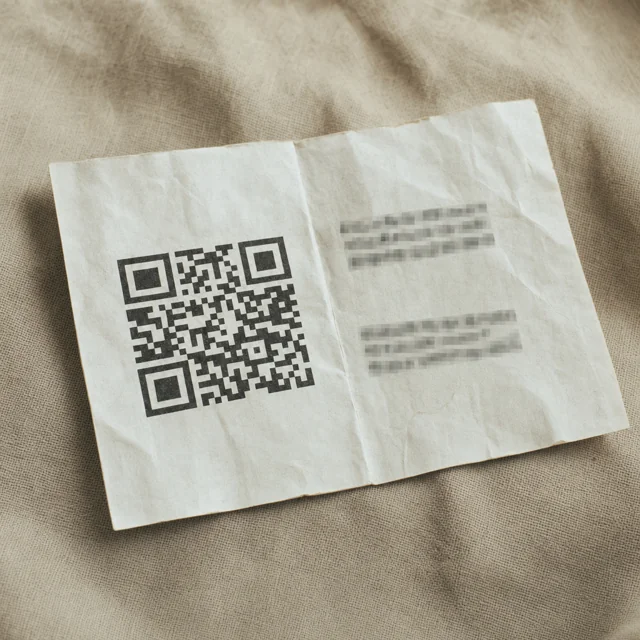
Why paper wallets are fragile in an estate
- If the printed private key is unencrypted, someone who copies it may be able to access the corresponding crypto. Treat every private part found as a secret. Some paper wallets use an encrypted key that also requires a password. A photograph, a scan, or a copy sent “for help” can expose the access the family needs.
- The paper itself can degrade, fade or tear. Preservation is a physical problem, not just a digital one.
- The public address can be checked on a block explorer, but a visible balance proves nothing about access or title, see why a visible wallet balance does not prove access or ownership.
How to preserve it
- Keep the whole sheet flat, dry and out of direct light.
- Never photograph, scan or email any part of it (especially the private side) and never enter it anywhere just because a website or app looks official. First check in the current official documentation of the wallet concerned where and how recovery is supposed to take place (see official channels and source verification). With some hardware wallets you enter recovery words only on the device itself; with other wallets, an official app, software environment or web recovery procedure can be part of the normal recovery process. If what you see on screen differs from the official recovery procedure, or you are unsure, do not enter anything.
- Do not “test” it by importing it into a website or app. Enter the key only within a pre-verified and suitable recovery environment: compatible wallet software or hardware from a trusted official channel, or a controlled offline environment when specialist recovery is needed. Import sites that offer to “check” it are a common theft vector.
- Record only that a paper wallet exists, where, and when.
What to do with it
- The private key material can give technical control over the corresponding funds. With a classic paper wallet, the private key is the sensitive access material. If the sheet you found instead consists of recovery words, it is not a classic paper wallet but a seed backup, and you follow that wallet’s recovery route.
- When the estate is authorised and technically ready to act: first determine which controlled transfer or sweep method is appropriate for the format and network concerned. Once a private key is exposed during that process, it must afterwards be considered potentially compromised. Avoid partial test transactions without first understanding which outputs are used and how any change is handled.
- The classic mistake: “testing” it in a website or app exposes the key to whoever runs that site.
- Sweep versus import: for classic single-key Bitcoin paper wallets, a controlled sweep to a newly managed wallet can be more suitable than keeping the old private key imported long-term. Which method fits depends on the format, network and wallet software; do not run a partial test transaction without first understanding how change is handled.
- If the key is unreadable or incomplete: read what is realistically possible in wallet recovery.
- Until authority is confirmed, keep the whole sheet flat, dry and unphotographed.
Encrypted keys (6P / BIP38)
Some printed keys are encrypted: the private key starts with 6P and needs a password. Without the correct passphrase, the BIP38 record cannot be decrypted directly. Whether recovering an unknown passphrase is practically feasible depends on the search space and available clues; the password matters as much as the paper itself.
- Preserve the key and the password securely and appropriately, exactly as found; it can be sensible not to keep them together unprotected.
- Never type, photograph or scan either into a website, app or message, including tools that offer to “decrypt” or “check” it.
- If the password is missing, read what is realistically possible in wallet recovery.
What happens next
- Identify what the sheet actually is: address plus key, or a printed seed phrase. See what did you find.
- Confirm legal authority before anyone handles the private part, see legal authority vs technical access.
- When the estate is ready to act, spending from a paper wallet is careful work: the correct network, the correct amounts, and never a partial “test” that risks exposing the key. See wallet recovery: what is realistically possible for the limits.
For the full index of formats, see the wallet format library.
Sources and useful links
- BIP-39, Mnemonic code for generating deterministic keysSource accessed: 2026-08-12
- BIP-38, Passphrase-protected private keySource accessed: 2026-08-14