In this guide
After a death
The crypto estate timeline
What happens when in a crypto estate, from day one to month twelve: preservation, authority, access, valuation, reporting and distribution.
Every estate moves through the same stages, but never on a fixed clock. Courts, notaries, platforms and tax authorities all work at their own speed, which is why one estate closes in weeks and another takes a year or more. This page shows the shape of that timeline: what happens when, and why. It is deliberately not a promise.
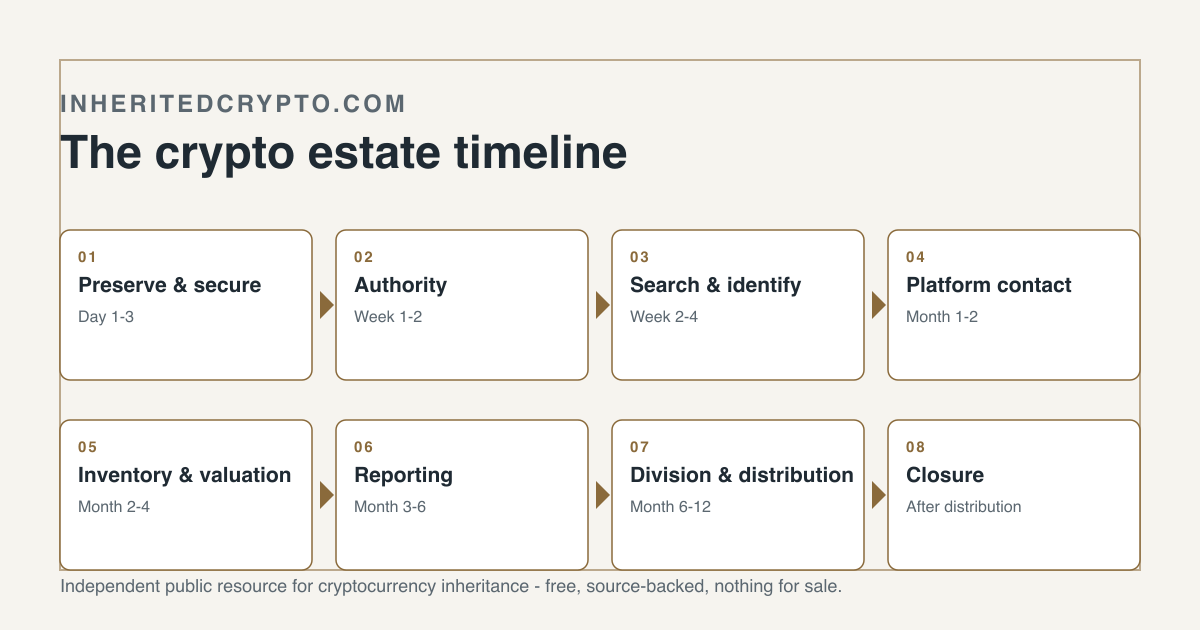
Shareable version of this page: the infographic above is free to post or forward. It shows indicative timing, every estate differs.
The timeline
Timings are indicative, every estate differs, stages can overlap, and external processes set the pace.
| Stage | Rough timing | What happens | Why this stage takes time or attention |
|---|---|---|---|
| Preservation and securing | Day 1–3 | Devices, wallets and documents are left untouched; the first notes are made; a trusted person is told | The estate is most fragile in the first days, a reset or a guessed PIN can close the only route |
| Authority begins | Week 1–2 | The executor, authorised heirs or any other authorised persons are identified; where formal proof is required for an action or institution, the appropriate authority document is applied for | Establishing authority and, where necessary, obtaining a grant of probate, certificate of inheritance or other proof can take time |
| Search and identification | Week 2–4 | The structured search runs: devices, documents, emails, financial records; found items are identified | The estate usually has multiple traces, and each takes time to locate and classify |
| Platform contact | Month 1–2 | Exchanges are contacted through their official procedure for customers who have passed away, with the required documents | Platforms verify documents carefully and run their own review; this is by design, not delay |
| Inventory and valuation | Month 2–4 | The full inventory is built and positions are valued for the estate | Every account, wallet and position must be listed and valued; some positions (DeFi, NFTs) need specific records |
| Reporting | Month 3–6 | Check which reporting and tax obligations and deadlines apply via the current information of the competent tax authority; involve a locally qualified tax professional where needed | Deadlines vary by country and by asset type; verification takes time |
| Division and distribution | Month 6–12 | The authorised persons carry out the appropriate administration, for example division, transfer or sale of inherited crypto, within the powers and rules that apply to the estate | Transfers require the authority, any document requirements of the institutions involved and the decisions of the authorised persons involved to all line up |
| Closure | After distribution | Records are kept, the file is closed, and any unresolved items are handed to the right person | The estate is not complete until every route has been followed or documented as closed |
What slows an estate down
- Missing or incomplete authority documents. Actions on behalf of the estate wait for the right person; preserving, documenting, gathering information and asking about procedures can continue in the meantime.
- Unknown holdings. If the search is slow, the inventory is late, and every later stage waits for it.
- Missing access material. With self-custody, recovery depends on the wallet type and the available recovery material; if essential material is missing, recovery can take a long time or be impossible. See wallet recovery: what is realistically possible.
- DeFi and NFT positions. Depending on the protocol, lock-ups, unbonding periods and marketplace processes may keep running and add steps.
- Platform verification. Exchanges review documents carefully. It is normal; it is not a signal that something is wrong.
- Multiple jurisdictions. Can bring additional legal, tax, documentation or procedural requirements. Check with each jurisdiction and authority involved which current rules actually apply. See cross-border crypto estates.
What speeds an estate up
- Clear coordination. Can reduce duplicate work and conflicting communication, to the extent roles and authority allow.
- A timely document file. A well-organised document file can prevent delay when documents are later requested by an institution or provider. See crypto estate documents explained.
- Early platform contact. Exchanges are contacted as soon as the authority document exists, not after the inventory is finished.
- A written search log. Knowing what was searched and found prevents redoing work and supports the inventory. See how to find crypto after a death.
- Honest expectations. The timeline is shorter when the family knows which stage depends on which external process.
Why the timeline matters
Much of the stress in a crypto estate comes from the gap between what families expect and what processes actually take, not from the technology itself. Platforms verify, courts schedule, tax authorities have calendars, and DeFi positions run on their own clocks. Knowing that gap is normal is what lets a family work calmly through it.
Next steps
For the full action list from day one, use the complete crypto inheritance checklist. For the first actions specifically, see first steps after a death, and for what happens legally, what happens to crypto after a death.
Quick answers to common questions
How long does a crypto estate take?
There is no universal timeline. Authority can take weeks or months, exchanges have their own processing times, and tax authorities work on their own calendars. The honest expectation is months, not days, and the correct order matters more than speed.
What most often slows an estate down?
Waiting on documents and authority, platform review times, valuation and tax deadlines, and unresolved access problems. Starting late with preservation, or acting before authority, makes every later step slower.
Can the process be sped up?
Preserve early, work in the correct order, prepare the documents before contacting institutions, and ask about deadlines early. Be extra cautious if someone pressures you to pay immediately or share secret information. Urgency by itself does not prove fraud: always first check who the party is, what exactly they will do, and which costs have been agreed.